Safety in construction
Georgia's deadliest sector: more deaths than any other industry in every year on record.
Last updated: 3 October 2026
Overview
Construction accounts for the largest number of workplace deaths in Georgia in every year for which data exist: 78 of the deaths recorded in 2019–2023 and 21 of the 32 deaths in 2025 (Fair Labour Platform data; Georgia Today, 2026). Falls from height, collapses and equipment accidents are the typical mechanisms recorded in inspection reports, although the Service does not publish a national breakdown by cause. The sector employed about 122,600 people in 2025, 8.8% of all employment (Geostat).
Key figures
78
Construction deaths, 2019–2023 — the highest of any sector
Fair Labour Platform data (2024)
21 of 32
Deaths in 2025 that occurred on construction sites
Georgia Today (2026)
≈15
GILS indicative fatal rate per 100,000 construction workers, 2019–2023 average — not comparable with Eurostat's standardised EU rate (see note)
GILS calculation; Eurostat
122,600
People employed in construction, 2025
Geostat
Employment and risk
GILS indicative rate: 78 deaths over five years ÷ average construction employment 2019–2023 (101.5 thousand) ≈ 15.4 deaths per 100,000 workers a year. The EU-27 standardised rate for construction was 6.1 per 100,000 in 2024 (Eurostat, hsw_n2_02). The two figures must not be read as a like-for-like comparison: Eurostat's standardised rate (6.1 per 100,000 in 2024) adjusts for sector structure and excludes road-traffic and transport deaths at work, while the GILS figure is a crude ratio of recorded deaths to Labour Force Survey employment and excludes the informal construction work that is largely unrecorded. It indicates an order of magnitude, not a ranking.
Rules and enforcement
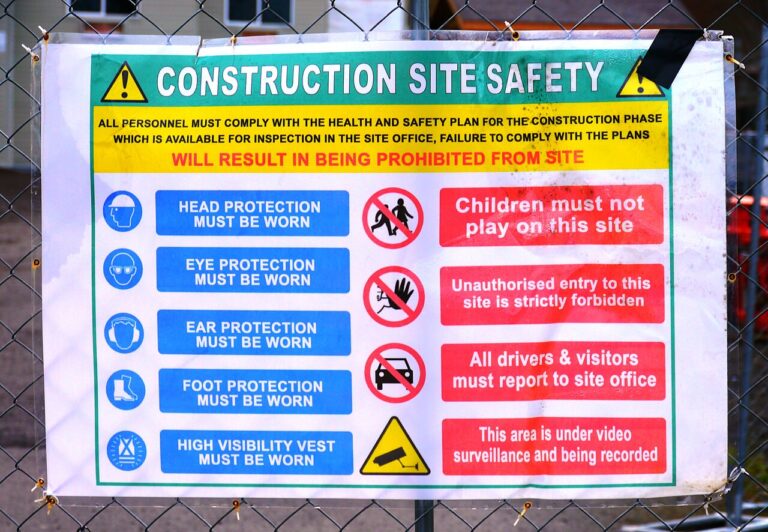
- Employers must assess risks, provide personal protective equipment and designate an accredited safety specialist under the Organic Law on Occupational Safety (2019).
- Inspectors may enter sites without notice and suspend work; 361 workplaces had operations suspended for safety violations in 2023 (Formula, 2024).
- EU benchmark: the Temporary or Mobile Construction Sites Directive 92/57/EEC, which requires coordinators and safety plans; it is among the directives listed for approximation under the Association Agreement and had not been reported as transposed by 2024 (ETF–Eurofound, 2024).
- ILO benchmark: the Safety and Health in Construction Convention, 1988 (No. 167) — not ratified by Georgia (ILO NORMLEX).
What employers must do
The duties below summarise what Georgian law requires and what the EU and ILO benchmarks add; "benchmark" marks instruments Georgia has not yet adopted. For a full self-assessment with an action plan, use the GILS Risk Assessment Checklist.
- Designate an accredited occupational safety specialist and keep a written, site-specific risk assessment, reviewed at each new phase
Basis: Organic Law on Occupational Safety (2019) - Provide collective fall protection first (guard rails, covers, scaffolds inspected by trained workers) and harnesses only where that is impossible
Basis: EU Directives 92/57/EEC and 2001/45/EC (benchmarks); 89/656/EEC on PPE, transposed - Shore or batter excavations, locate underground services, separate vehicles and pedestrians, control reversing
Basis: EU Directive 92/57/EEC (benchmark) - Control silica dust with water or extraction and respirators; survey for asbestos before refurbishment
Basis: EU Directive 2004/37/EC (benchmark); ILO Convention No. 162 - Provide drinking water, shade and rest in heat, welfare facilities, first aid, and free PPE that is worn
Basis: Organic Law on Occupational Safety (2019); ILO Recommendation No. 102 - Report every accident to the Labour Inspection Service and record near misses
Basis: Organic Law on Occupational Safety (2019); ILO Protocol of 2002
This summary is general information, not legal advice; the written risk assessment and the accredited safety specialist remain the legal requirements under the Organic Law on Occupational Safety.
Public health perspective (WHO)
Beyond falls and collapses, construction carries the disease burden WHO measures: silica and asbestos exposure (respiratory disease and cancer), noise (hearing loss), ergonomic load (musculoskeletal disorders) and heat. In the WHO/ILO Joint Estimates these risk factors cause far more deaths than injuries worldwide (WHO and ILO, 2021). None is recorded for Georgian construction workers. Workers' health: the public health perspective.
Data gaps
- No published breakdown of construction accidents by cause, by size of enterprise or by contract type.
- Informal construction work, common in housing and renovation, is outside the recorded data.
- No figure for 2024.
Sources
- Georgia Fair Labour Platform (2024). Workplace Death & Injury Statistics (archived copy). web.archive.org
- Georgia Today (2026). Labour Inspection Service 2025 report. georgiatoday.ge
- Geostat (2026). Employment by economic activity. www.geostat.ge
- Eurostat. Fatal accidents at work by NACE activity (hsw_n2_02). ec.europa.eu
- ETF–Eurofound (2024). Working life in Georgia. www.etf.europa.eu
- Formula News (2024). Labour Inspection Service: 3,765 safety inspections and 361 suspensions in 2023 (in Georgian; cited from the Service's 2023 report).
Figures are from the GILS Evidence Register and the official sources shown. GILS is independent of government, trade unions, employers' organisations and the ILO.
In this section
← OSH hubTwo perspectives: ILO and WHO · National OSH Profile · Normative instruments · International standards · Law and institutions · Accidents and deaths · Occupational diseases · Chemical hazards · Noise, vibration and radiation · Ergonomics and musculoskeletal disorders · Psychosocial risks at work · Construction · Mining · Agriculture · Heat and climate · Health workers · Infection and sharps · Violence · Health workers: burn-out · Women at work · Young and older workers · Workplace action and training
GILS analyses on this topic
 Labour Inspection in Georgia Five Years After the Full Mandate: More Inspections, an Unratified Convention — and the Evidence Still MissingGeorgia's Labour Inspection Service has had a full mandate only since 2021. Inspections have grown fast, but Convention No. 81 is still unratified, staffing data are out of…
 Georgia Wire: Parliament Hears the Labour Inspection Service’s 2025 Report — Five Years After the Full MandateParliament's Economic Policy Committee has heard the Labour Inspection Service's report for 2025: 7,111 inspections, 3,709 facilities inspected for the first time, and a reported 46% fall in…
 Georgia Has Not Ratified the ILO’s Fundamental Safety Conventions: Why C155 and C187 MatterIn 2022 the International Labour Conference made a safe and healthy working environment a fundamental principle and right at work, raising the ILO's two framework conventions on occupational…
 Georgia Wire: 32 Workplace Deaths in 2025, Two-Thirds in Construction — What the Labour Inspection Data ShowThe Labour Inspection Service recorded 32 workplace deaths and 179 injuries in 2025, and reported a 46% fall in fatal accidents compared with the previous year. Construction accounted…