National OSH Profile of Georgia
A country profile of Georgia's occupational safety and health system in the structure the ILO uses for national OSH profiles — compiled by GILS from published sources.
Last updated: 3 October 2026
About this profile
The ILO asks member states to prepare a national OSH profile — an inventory of the laws, institutions, data, services and capacities that make up a country's OSH system — as the basis for a national programme under Convention No. 187 (Article 4) and Recommendation No. 197. Georgia has not published one. This page is a GILS compilation in the ILO's profile structure, built only from published sources; each item links to the evidence. It is not an official document and is updated as sources change.
Download the profile as PDF (version 1.0, 5 October 2026, 3 pages). Suggested citation: GILS Research Team (2026). National OSH Profile of Georgia: a compilation in the ILO profile structure, version 1.0. Georgian Institute of Labour Studies, PHIG. Licence CC BY 4.0.
1. Legal framework
| Element | Georgia |
|---|---|
| Constitution | Article 26 guarantees labour rights; Georgia is party to the European Social Charter (revised) in part |
| Principal OSH law | Organic Law on Occupational Safety (2019), replacing the Law of March 2018; applies to all sectors |
| Labour Code | Organic Law of 2010 as amended in 2020; working time, night work, harassment, maternity |
| Inspection law | Law on the Labour Inspection Service (2020) |
| EU directives transposed | Five individual OSH directives, 2022–2023 (workplace; PPE; manual handling; display screens; safety signs); Framework Directive 89/391/EEC not yet transposed |
| ILO OSH conventions ratified | None of the OSH-specific conventions; 19 conventions in total, including 8 of the 10 fundamental conventions |
Sources: ETF–Eurofound (2024); ILO NORMLEX; see Law and institutions.
2. Competent authorities and coordination
| Body | Function |
|---|---|
| Ministry of Internally Displaced Persons from the Occupied Territories, Labour, Health and Social Affairs | Policy; the Labour Inspection Service sits under it |
| Labour Inspection Service | Inspection, accident investigation, sanctions, annual report to Parliament; 7,111 inspections in 2025 |
| Tripartite Social Partnership Commission | National tripartite body; the forum for OSH policy consultation with the Georgian Trade Unions Confederation and the Georgian Employers' Association |
| Parliament | Hears the Service's annual reports; adopts OSH legislation |
| Public Defender | Monitors labour rights including safety |
Sources: Parliament of Georgia (2026); ETF–Eurofound (2024); see Social Dialogue.
3. Occupational health services and specialists
- Employers must designate an occupational safety specialist who has completed an accredited training programme (Organic Law on Occupational Safety).
- No general obligation to provide occupational health services for all workers; Convention No. 161 not ratified.
- Occupational medicine capacity and the list and recognition procedure for occupational diseases are not documented in published sources; see Occupational diseases.
4. Recording, notification and statistics
- Accidents are reported to and recorded by the Labour Inspection Service, which publishes annual totals of deaths and injuries; breakdowns by sector and region were published for 2019–2023; no 2024 figure in accessible sources.
- Occupational diseases are not recorded in published statistics.
- Geostat publishes no OSH statistics; Georgia does not report to ILOSTAT's OSH tables in accessible form.
- The Protocol of 2002 to Convention No. 155, which sets the standard for recording and notification, is not ratified.
- See Accidents and deaths: the record and the open dataset.
5. Compliance and enforcement
- Inspectors may enter workplaces without notice, order corrective measures, impose fines of GEL 100–50,000 and suspend work (2019 law).
- 3,765 safety inspections and 361 suspensions in 2023; 7,111 inspections in 2025.
- Civil society organisations reported that warnings were the main sanction regardless of severity (Social Justice Center et al., 2023).
- Workplace deaths fell from 59 (2018) to 32 (2025).
6. Education, training and information
- Accredited training programmes for occupational safety specialists, required by law.
- ITCILO courses in OSH are open to Georgian participants; GILS lists them on its Certificate Courses page.
- No national OSH information centre of the kind recorded in the ILO's INTEROSH database was found in published sources.
7. Social dialogue on OSH
- The Tripartite Social Partnership Commission is the national consultation body; Convention No. 144 on tripartite consultation is ratified (2018).
- Collective agreements in force fell from 165 (2013) to 52 (2020); bargaining coverage is estimated at 11–14% (ILO).
- The Georgian Trade Unions Confederation called in 2019 for ratification of Conventions No. 176, No. 183 and No. 156.
8. Research and data on hazards
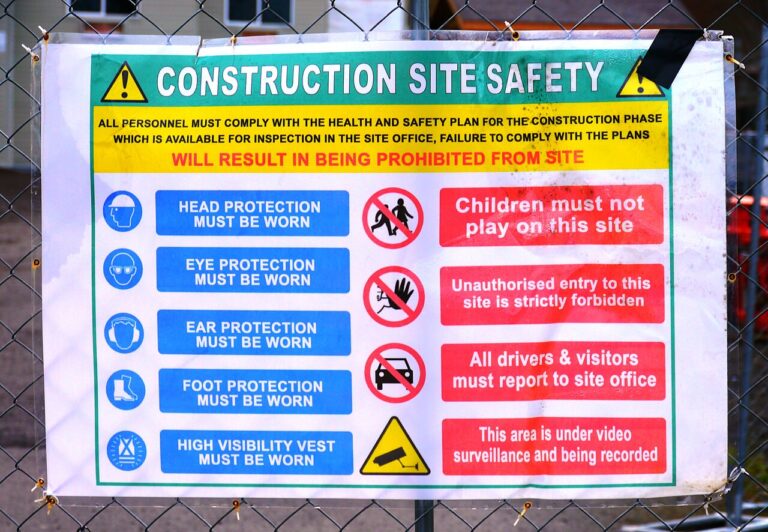
- Sector pages on this site: construction, mining, agriculture; hazard pages: heat and climate, infection and sharps, violence, psychosocial risk.
- No national working-conditions survey exists; the GILS 2027 survey of health workers will be the first sector survey.
9. International cooperation
- First ILO Decent Work Country Programme signed in August 2024.
- EU–Georgia Association Agreement, Annex XXX: approximation to EU OSH directives.
- ETF and Eurofound: Working life in Georgia (2024) country profile.
Public health perspective (WHO)
WHO's plan asks each country for a national profile and programme on workers' health, developed jointly by the health and labour ministries with employers and workers (WHA60.26). The ILO profile structure used here therefore has a health-system counterpart: occupational health services coverage, surveillance of occupational disease, health promotion at work, and the occupational health of health workers. For Georgia, each of these is unrecorded in published sources. Workers' health: the public health perspective.
Legal sources (Matsne, with article numbers)
Statutory references on this page are to the following acts in the Legislative Herald of Georgia (Matsne), with the articles relied on. English translations on Matsne are official for the Labour Code and the Labour Inspection law; the Occupational Safety law's English text is an unofficial translation.
| Act | Official text | Articles relied on |
|---|---|---|
| Organic Law — Labour Code of Georgia (No. 4113-რს, 17 December 2010, as amended; major amendment No. 7177, 29 September 2020) | Matsne 1155567 | Art. 2 and 4 — discrimination, harassment and sexual harassment, equal pay for equal work; Art. 10 — minimum age 16 (14 with consent for light work), hazardous work barred for minors and pregnant women; Art. 17 — probation up to 6 months; Art. 24 — 40-hour week, 48 hours in listed sectors, 12-hour daily and 24-hour weekly rest, working-time records; Art. 27 — overtime; Art. 28 — night work 22:00–06:00, barred for minors and pregnant women, 8-hour cap in hazardous work; Art. 31 — 24 working days' paid leave, 10 extra days for hazardous work; Art. 37 and 39 — maternity leave 126 days, state benefit; Art. 45 — safe and healthy working environment, right to refuse dangerous work, employer's duty to compensate harm; Art. 47–49 — termination grounds, notice and compensation, collective redundancies; Art. 52–57 — freedom of association, collective agreements; Art. 61–67 — disputes, mediation, strike and lockout, essential services; Art. 70 — information and consultation through elected employee representatives in enterprises of 50 or more |
| Organic Law of Georgia on Occupational Safety (19 February 2019; replaced the Law of March 2018) | Matsne 4486188 | Employer duties, risk assessment, designation of an occupational safety specialist, workers' rights, inspection powers and sanctions; applies to all sectors |
| Law of Georgia on the Labour Inspection Service (No. 7178-Iს, 29 September 2020) | Matsne 5003057 | Art. 2 — legal status; Art. 4 — governing acts; Art. 5 — aim and functions; Art. 13–16 — inspection powers; Art. 20 — reporting |
| Government Decree No. 381 — list of heavy, harmful and hazardous works | Matsne (Georgian) | Defines hazardous work for the purposes of the Labour Code and the Occupational Safety law |
| Government Decree No. 597 — sectors with specific working regimes (48-hour week) | Matsne (Georgian) | Implements Labour Code Art. 24(3) |
Consolidated versions change; the links open the current consolidated text. GILS cites the version in force at the date of the page's "Last updated".
Sources
- ILO. National OSH Profiles portal. www.ilo.org
- ILO. Promotional Framework for OSH Convention, 2006 (No. 187) and Recommendation No. 197. normlex.ilo.org
- ETF–Eurofound (2024). Working life in Georgia. www.etf.europa.eu
- Parliament of Georgia (2026). Economic Policy Committee heard the Labour Inspection Service. parliament.ge
- Social Justice Center et al. (2023). Submission to the UN CESCR (archived copy). web.archive.org
- ILO NORMLEX. Ratifications for Georgia. normlex.ilo.org
Figures are from the GILS Evidence Register and the official sources shown. GILS is independent of government, trade unions, employers' organisations and the ILO.
In this section
← OSH hubTwo perspectives: ILO and WHO · National OSH Profile · Normative instruments · International standards · Law and institutions · Accidents and deaths · Occupational diseases · Chemical hazards · Noise, vibration and radiation · Ergonomics and musculoskeletal disorders · Psychosocial risks at work · Construction · Mining · Agriculture · Heat and climate · Health workers · Infection and sharps · Violence · Health workers: burn-out · Women at work · Young and older workers · Workplace action and training
GILS analyses on this topic
 Labour Inspection in Georgia Five Years After the Full Mandate: More Inspections, an Unratified Convention — and the Evidence Still MissingGeorgia's Labour Inspection Service has had a full mandate only since 2021. Inspections have grown fast, but Convention No. 81 is still unratified, staffing data are out of…
 Georgia Wire: Parliament Hears the Labour Inspection Service’s 2025 Report — Five Years After the Full MandateParliament's Economic Policy Committee has heard the Labour Inspection Service's report for 2025: 7,111 inspections, 3,709 facilities inspected for the first time, and a reported 46% fall in…
 Georgia Has Not Ratified the ILO’s Fundamental Safety Conventions: Why C155 and C187 MatterIn 2022 the International Labour Conference made a safe and healthy working environment a fundamental principle and right at work, raising the ILO's two framework conventions on occupational…
 Georgia Wire: 32 Workplace Deaths in 2025, Two-Thirds in Construction — What the Labour Inspection Data ShowThe Labour Inspection Service recorded 32 workplace deaths and 179 injuries in 2025, and reported a 46% fall in fatal accidents compared with the previous year. Construction accounted…